Android application
Travel Record Manager
Your Journeys. One Place.
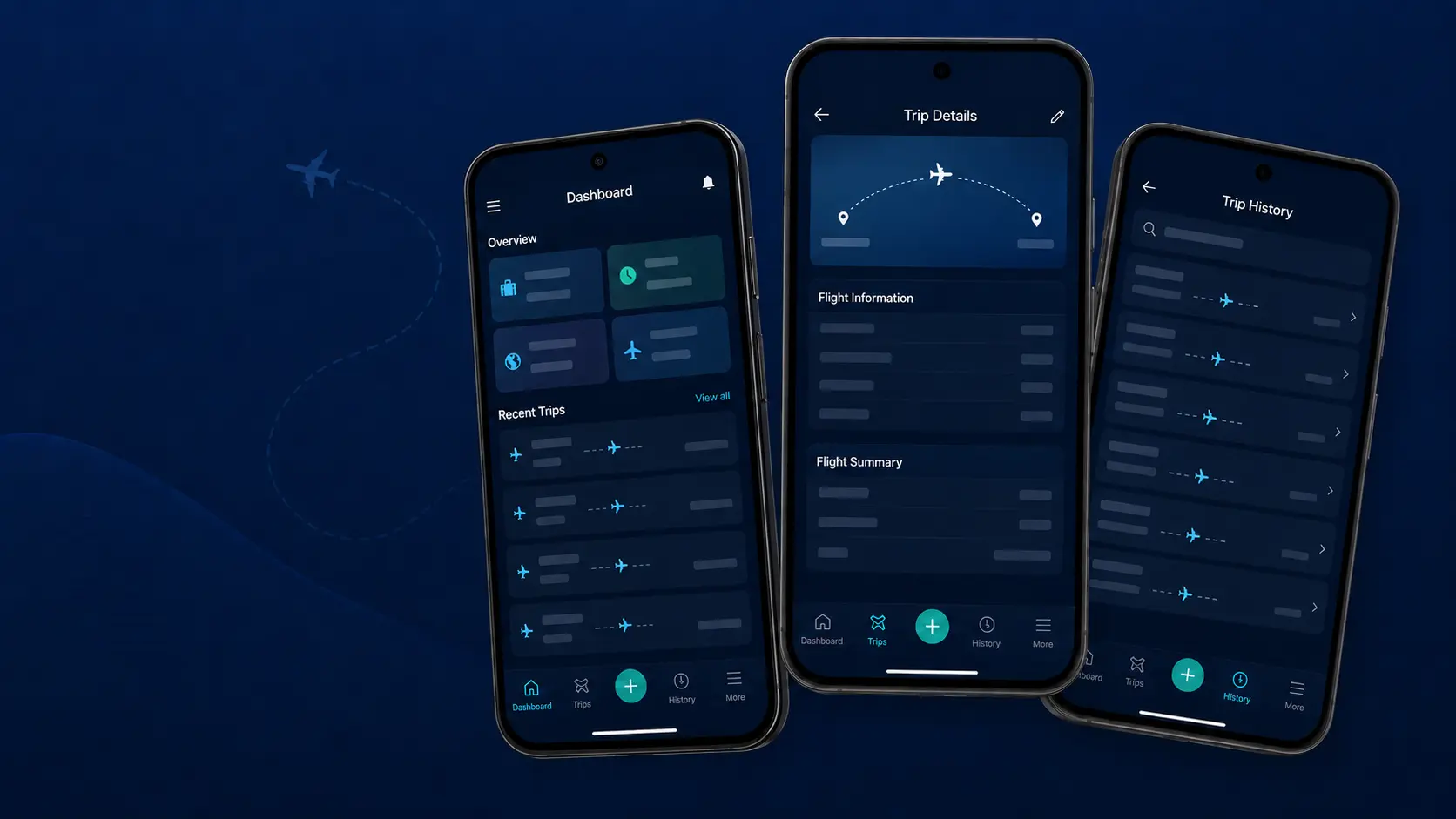
Travel Record Manager is an offline-first Android application developed through AI-assisted iterative engineering. It transforms a standalone travel-record database into a structured mobile solution for managing journeys, itineraries, accommodation, traveler information and supporting documents.
01 · Context
The Challenge
Travel information is often scattered across emails, spreadsheets, booking applications, screenshots, PDF tickets and loyalty-program accounts. The central engineering challenge was to convert an existing standalone HTML travel-record system into a structured Android application while preserving its data, features and offline capability.
- Bring flight, train, bus, car and hotel records into one coherent workflow.
- Keep multiple journey segments organized under the same booking reference.
- Reduce inconsistent city and country entries that weaken travel statistics.
- Migrate legacy spreadsheet and HTML records without changing historical dates.
- Keep essential travel information available without depending on an internet connection.
- Provide privacy-conscious, user-controlled storage that remains understandable for nontechnical users.
02 · Response
The Solution
The resulting offline-first application provides one location for maintaining personal and official travel records. Controlled directory selections improve consistency while local storage, import and backup capabilities support continuity.
Journey Management
- Trips and multi-segment itineraries
- Flight, train, bus and car records
- Hotel bookings and document attachments
Reference Directories
- Airlines, trains and transport providers
- Cities, countries and time zones
- Embassy and consulate information
Traveler Information
- Traveler profiles
- Loyalty and frequent-flyer accounts
- First-time onboarding and profile setup
Data & Continuity
- JSON backup and restoration
- CSV, Excel and JSON import support
- Offline reports and visited-location summaries
03 · Contribution
Engineering & Digital Contribution
Requirements & Product Design
- Converted a practical workflow into structured functional requirements.
- Defined PNR grouping, segment-level statistics and travel-type-specific fields.
- Specified continuity rules for home-city, nationality and historical records.
Data Architecture & Migration
- Modelled trips, segments, hotels, travelers, directories, loyalty accounts and attachments.
- Mapped legacy Excel and CSV fields with validation, normalization and duplicate controls.
- Designed JSON backup, reference-data seeding and local database versioning.
Android Application Engineering
- Packaged the web application for Android using Capacitor.
- Configured responsive layouts, touch controls, file handling and offline storage.
- Prepared Android assets, project configuration and APK builds through Android Studio and Gradle.
User Experience Design
- Created step-by-step onboarding and a replayable user guide.
- Added searchable selections, context-sensitive forms and automatic reference completion.
- Designed clear add, view, edit, delete, confirmation and backup workflows.
04 · Quality approach
Engineering Quality Applied to Digital Development
Development followed an iterative QA/QC approach in which each requirement and correction was reviewed against observed application behaviour on a real Android device.
- Requirements
- Build
- Device Testing
- Defect Review
- Corrective Action
- Regression Verification
- Requirement-by-requirement verification
- Import and date-structure validation
- Navigation, form and mobile-layout testing
- Corrective-action and regression checks
05 · Development approach
AI-Assisted Iterative Development
The application used a vibe-coding workflow, but the work was not based on unstructured prompting alone. A real requirement was converted into features and data fields, tested on a real device, corrected through observed evidence and released through versioned iterations.
AI-assisted iterative application development with human-led requirements, testing and quality assurance.
AI supported
AI supported implementation, coding assistance, debugging, requirement refinement and rapid prototyping.
Human-led responsibility
- Defining the problem and providing domain knowledge
- Reviewing functionality and identifying defects
- Approving design decisions
- Validating the final workflow
06 · Professional value
Outcome
The project produced a functional Android travel-management application that brings personal travel information into a structured, user-controlled mobile workflow.
- Centralized personal travel database
- Offline access to essential records
- Clearer management of complex itineraries
- More consistent travel statistics
- Legacy-data migration support
- User-controlled backup and restoration
Future Roadmap
- Google Play deployment
- Optional cloud synchronization
- Notifications and biometric access
- Intelligent travel assistance
Methods
Technologies & Methods
Application
Data
Android
Approach
Skills Demonstrated
 Conceptual visual · fictional data
 Conceptual visual · fictional data